


Choosing a China-based supplier for an Sds Plus Hammer Drill takes more than comparing prices. Global buyers need to examine motor performance, impact energy, chuck quality, and how comfortably the tool handles overhead work. A drill that looks solid in a product photo may feel different after a full shift. Small details matter.
For this guide, the quoted specialist is a fictional editorial persona, not a verified interview source. Daniel Wu, a fictional power-tool sourcing specialist, offers this practical principle: “A dependable drill is not defined by its strongest specification, but by how consistently it performs under ordinary working conditions.” Buyers can use that idea when reviewing factory capabilities, sample quality, packaging, spare-parts support, and communication. Ask for clear product documentation. Check the details.
China’s manufacturing market includes suppliers with different levels of technical depth and export experience. This outline will help global buyers compare manufacturers without treating every catalog claim as proof. It will also consider application needs, quality checks, customization, and after-sales service. One limitation deserves attention: a promising sample cannot guarantee consistent production. That deserves a second look.
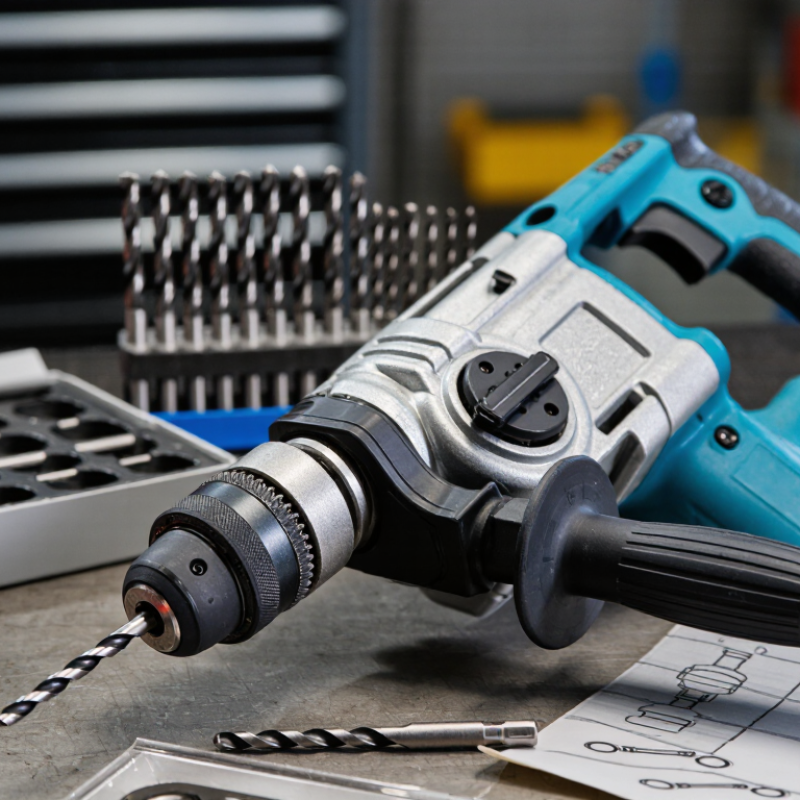
An SDS Plus hammer drill combines rotation with rapid axial impacts to bore into masonry. Its “Plus” bit has two open drive slots and two retaining grooves in the shank. The slots transfer torque; the grooves let the chuck hold the bit while it moves slightly back and forth. Inside the tool, a motor drives a piston that compresses air, pushing a striker against the bit. The operator does not need to press hard. Let the mechanism work.
That differs from a standard hammer drill, which usually creates impacts through gears and transfers more vibration to the bit. SDS Plus tools suit concrete and brick, but the correct bit matters: a masonry bit with the matching shank is essential. On site, a dusty hole or a blunt tip can slow drilling and make the tool feel less powerful. Small details matter.
Dust control matters too. OSHA’s Respirable Crystalline Silica standard sets an eight-hour permissible exposure limit of 50 micrograms per cubic meter and an action level of 25 micrograms per cubic meter. Its Table 1 guidance for handheld rotary hammer drilling calls for a shroud and dust-collection system. These figures are not tool-performance ratings; they describe exposure limits. That distinction is easy to miss. A practical setup pairs the right bit with steady pressure, a side handle, and suitable dust extraction. Even then, concrete varies, so drilling speed may not match expectations.
| Topic | Fact or Specification | What Global Buyers Should Know |
|---|---|---|
| What an SDS Plus hammer drill is | A rotary hammer designed for drilling in materials such as concrete and masonry, using a compatible SDS Plus accessory connection. | It combines rotation with a hammering action. It is not the same as a standard drill that relies only on a mechanical impact mechanism. |
| How the hammer mechanism works | In a common electro-pneumatic design, a motor drives a piston that compresses air. The air moves a striker, which transfers impact energy to the bit through an intermediate component. | Impact energy, impact rate, and drilling performance depend on the complete tool design and should be checked in the manufacturer’s technical documentation. |
| SDS Plus shank | The SDS Plus system uses a nominal 10 mm bit shank with four longitudinal grooves. Two open grooves transmit rotation, while two closed grooves help retain the bit. | Confirm accessory compatibility before purchase. SDS Plus, SDS Max, and other shank systems are not interchangeable. |
| Bit changing | SDS Plus accessories are typically inserted into the tool holder and retained by its locking mechanism; a separate chuck key is not normally required. | Follow the tool’s instructions when fitting or removing bits. Check that accessories are correctly seated and suitable for the tool and application. |
| Operating modes | Many models offer rotation-only and rotary-hammer modes. Some also provide hammer-only operation for light chiselling. | Mode availability varies by model. Buyers should verify the switch positions and permitted applications rather than assume every tool includes all three modes. |
| Typical applications | Common uses include drilling anchor holes in concrete or masonry and, on models with hammer-only mode, limited chiselling work. | Choose the tool and accessory for the material, hole size, duty cycle, and task. Follow the rated capacity and operating limits stated by the manufacturer. |
| Capacity and performance | Maximum drilling diameter, rated input power, impact energy, and no-load speed are model-specific specifications, not fixed characteristics of the SDS Plus system. | Compare published test conditions and specifications. Do not treat a maximum diameter as a recommended continuous drilling size. |
| Safety features to check | Depending on the design, a tool may include features such as an auxiliary handle, a depth stop, overload protection, or a safety clutch. | Check which features are included in the offered configuration. Use appropriate eye, hearing, and respiratory protection for the work environment. |
| Manufacturer evaluation | Assess technical documentation, product consistency, quality-control procedures, spare-parts availability, and after-sales support. | Request model-specific datasheets, applicable conformity documents, warranty terms, and sample inspection details before placing an order. |
| Export and sourcing checks | Electrical ratings, plug type, packaging, labeling, and documentation can vary by destination market and order configuration. | Confirm destination-country requirements, voltage and frequency compatibility, included accessories, lead times, and shipping terms in writing. |
Specifications and features vary by model. Verify all performance figures, compatibility details, and compliance requirements against the product documentation for the exact tool being purchased.