


Rotary Sensors convert shaft movement into signals that machines can read. Their accuracy can affect robot joints, packaging lines, wind turbines, and medical equipment. Yet choosing a supplier involves more than comparing resolution figures. Buyers must weigh sensing technology, operating range, environmental protection, output compatibility, documentation, and long-term support.
Small details matter. A connector may face repeated vibration. A sensor may need to fit inside a narrow housing. One overlooked interface can delay commissioning. No supplier is ideal for every application, and published specifications do not always reveal how a product performs after years of use. That is the awkward part.
Physicist and measurement pioneer Lord Kelvin wrote, “When you can measure what you are speaking about, and express it in numbers, you know something about it.” His principle remains useful when assessing Rotary Sensors, though measurements alone cannot tell the whole story. This guide compares ten suppliers for global buyers, focusing on product range, application fit, technical information, and service considerations. It is a practical starting point, not a universal ranking. Buyers should verify current specifications directly with manufacturers and test shortlisted sensors in their actual operating conditions. A careful comparison can narrow the field. It cannot remove every uncertainty.
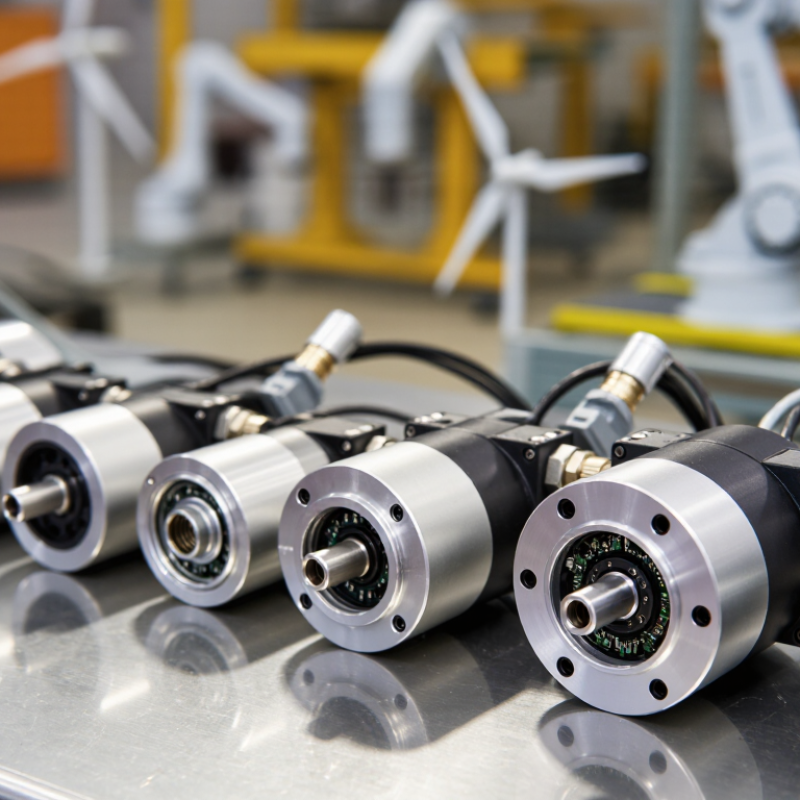
Rotary sensors track motion around a shaft. Depending on design, they measure angular position, rotational speed, direction, or accumulated turns. Incremental encoders count pulses as a shaft moves; absolute sensors report a distinct position, even after power returns. Resolvers can provide position feedback in demanding environments.
A useful distinction: resolution is not the same as accuracy. Installation alignment, vibration, and electrical noise can all affect the reading.
These measurements help control robot joints, machine-tool spindles, conveyor drives, and turbine adjustment mechanisms. The International Federation of Robotics reported 541,302 industrial robots installed worldwide in 2023 in World Robotics 2024.
That figure describes robot installations, not sensor sales, but it shows the scale of equipment that depends on precise motion feedback.
On a production line, a sensor may help a controller stop an arm at a repeatable angle or detect a slipping drive. Small details matter. A sensor’s range, response time, and environmental rating should match the machine. It is easy to focus on resolution and overlook mounting conditions; in practice, that can be an expensive mistake.

Global buyers should assess rotary sensor suppliers against operating conditions, not catalogue claims. A sensor on a robot joint faces repeated motion, vibration, temperature shifts, and electrical noise. The International Federation of Robotics reported 541,302 industrial robot installations in 2023, compared with 553,052 in 2022. These figures in its World Robotics 2024 and 2023 reports show the scale of automation demand, but also its year-to-year variation. Buyers should confirm that a supplier can support the actual application, rather than relying on broad market forecasts. Ask for test data covering resolution, linearity, repeatability, and service life under specified conditions.
Request a sample and test it on the intended shaft, coupling, and control system. Check the interface, connector pinout, sealing rating, and mounting tolerances against the machine design. Small details matter. Ask how calibration is traceable, what inspection records accompany each batch, and how design changes are communicated. ISO 9001 certification can indicate a quality-management system; it does not prove a sensor meets your performance requirements. Compare lead times, minimum order quantities, warranty terms, and technical support across regions. I would still question unusually tight accuracy claims unless the supplier provides a defined test method and uncertainty figures. A clear failure-analysis process can be more valuable than a polished brochure.
Profile One is a precision-focused supplier for compact encoders used in robotics. Look for repeatability data and clear mounting drawings.
Profile Two specializes in rugged rotary sensors for machinery exposed to vibration, dust, or moisture. Ask how test conditions match your site.
Profile Three serves vehicle and mobile-equipment applications, where connector security and temperature range matter.
Profile Four offers contactless magnetic sensing for designs with limited space. Check its stated accuracy across the full rotation.
Profile Five concentrates on optical sensors, which can provide fine resolution but may need careful protection from contamination.
Profile Six supports industrial control systems with common signal outputs and configuration help.
Profile Seven builds custom shaft and housing options for unusual installations. Custom work can add lead time.
Profile Eight focuses on high-volume production and stable product revisions. Request change-control details, not only a low unit price.
Profile Nine supplies measurement-grade devices for laboratory or calibration tasks. Review traceability documents and stated uncertainty.
Profile Ten emphasizes service, documentation, and replacement availability across regions.
These profiles describe supplier strengths, not guaranteed performance; verify every claim against a current datasheet and sample test. Fit matters.
Compare resolution, repeatability, electrical interface, operating temperature, and mechanical tolerances against the actual assembly. A sensor may look suitable on paper yet fail at the cable exit or mounting face.
I would also question any specification that lacks a test method. Ask for evidence.
Rotary sensor suppliers vary less by catalog size than by measurement approach and application support. Potentiometric designs can suit cost-sensitive position feedback, while optical, magnetic, and inductive options address different needs for resolution, durability, or contactless sensing. No technology wins everywhere. A supplier’s stated accuracy also means little unless its test conditions match the buyer’s operating range.
Compare capabilities against the actual installation. Check shaft play, repeatability, electrical output, sealing, temperature range, and connector options. A sensor beside a vibrating motor may need different protection from one inside a clean control cabinet. Ask for test reports and samples, then verify readings with your controller. That matters. Lead times and calibration services can separate capable suppliers, even when their specifications look similar.
Market focus offers useful clues. Suppliers serving factory automation may provide broad output choices, while those supporting mobile machinery may emphasize shock resistance and sealed housings. These are tendencies, not guarantees. A polished datasheet can hide unclear tolerances, and a low price can become costly if integration takes weeks. No simple ranking captures every trade-off; compare documentation, response quality, and production consistency alongside the sensor itself.
Encoder resolution is shown as theoretical discrete positions per revolution, calculated as 2n for an n-bit single-turn encoder. Higher resolution does not necessarily mean higher measurement accuracy. This engineering benchmark is technology-neutral and is not a supplier ranking.
For global buyers, sourcing a rotary sensor starts with the machine, not the catalogue. Define the rotation range, required resolution, repeatability, and output interface before requesting quotations. A sensor for a slow valve may not suit a fast motor shaft. Check shaft dimensions, mounting space, and cable exit direction against the actual assembly. Small details matter. Ask suppliers to explain how they test accuracy and whether calibration records can accompany each shipment. A clear datasheet helps, but a sample mounted on your equipment can reveal fit or signal issues that specifications miss.
Compare more than unit price. Confirm production lead times, minimum order quantities, packaging, warranty terms, and the process for handling defects across borders. Ask for written confirmation of operating temperature, vibration limits, and protection against dust or moisture, especially if the sensor will sit near coolant or outdoor machinery. Test the real assembly. Communication quality is also a sourcing factor: can the supplier answer technical questions consistently and share realistic delivery updates? I would not treat a polished quotation as proof of reliability; details sometimes change between samples and production. Record agreed specifications and inspection criteria before placing a larger order.
The entries below are technology-based supplier categories, not named companies or a ranked list. Capabilities and specifications vary by model; confirm the exact product datasheet, qualification status, and commercial terms with each supplier.
| Supplier technology category | Typical operating principle | Potential strengths | Points to verify | Key international sourcing factors |
|---|---|---|---|---|
| 1. Conductive-plastic potentiometric sensors | A wiper moves across a resistive element to provide an analog output proportional to shaft position. | Absolute position indication without a separate position-counting step; simple analog interfacing. | Electrical travel, independent linearity, output loading, mechanical life, and resistance to vibration and contamination. | Request the specified test method and life-cycle conditions; confirm shaft, mounting, connector, and calibration options. |
| 2. Wirewound potentiometric sensors | A moving contact traverses a wire-wound resistive track. | Straightforward analog measurement and a well-established construction. | Output smoothness, resolution limits from the winding, contact behavior, electrical angle, and wear life. | Check whether the output behavior suits the control system; obtain sample test results and change-notification terms. |
| 3. Optical incremental encoders | An optical pattern and detector generate pulses as the shaft rotates; position is commonly derived by counting pulses. | Useful for speed and relative-position measurement; available with common quadrature outputs. | Pulses per revolution, maximum speed, output-driver type, index channel, alignment, and susceptibility to dust or condensation. | Match the electrical interface to the controller and confirm startup/reference procedures after power loss. |
| 4. Optical absolute encoders | Optical code tracks provide a position value associated with shaft angle. | Can report an absolute position after power-up, depending on design and interface. | Single-turn or multi-turn range, bit resolution, accuracy, repeatability, output protocol, and environmental sealing. | Confirm protocol compatibility, configuration tools, firmware support, and availability of traceable test documentation. |
| 5. Magnetic rotary encoders | Magnetic sensing elements detect the field from a rotating magnet or coded magnetic target. | Contactless sensing can support compact designs and can be less exposed to optical contamination. | Magnet alignment and air gap, field strength, stray-field effects, temperature range, and accuracy over the full operating range. | Request installation tolerances and immunity data for the actual assembly; verify magnet sourcing and configuration control. |
| 6. Inductive rotary encoders | Electromagnetic coupling between patterned conductors and sensing coils is used to determine angular position. | Contactless measurement; some designs avoid a separate permanent magnet at the rotor. | Permitted air gap, mounting eccentricity, nearby conductive materials, accuracy, speed limits, and interface details. | Evaluate performance in the final mechanical stack-up and request EMC and environmental test conditions. |
| 7. Resolver suppliers | A rotary transformer produces sine and cosine signals related to shaft angle and typically requires excitation and signal conversion. | Suitable for demanding motion-control environments when paired with compatible resolver-to-digital electronics. | Excitation requirements, transformation ratio, electrical accuracy, speed, winding connections, and converter compatibility. | Confirm the complete sensor-and-converter interface, insulation requirements, and qualification evidence for the target application. |
| 8. Hall-effect angle sensors | Hall elements measure magnetic-field components from a rotating target to estimate angle. | Contactless measurement and electronic output options in compact packages. | Required magnet geometry, field range, temperature drift, calibration, output format, and diagnostic features. | Ask for application-specific calibration guidance and verify whether the supplier provides the target magnet or assembly. |
| 9. Capacitive rotary sensors | Changes in capacitance between patterned electrodes are processed to determine angular position. | Contactless sensing is possible, with performance dependent on electrode geometry and signal processing. | Air gap, moisture and contamination effects, electromagnetic compatibility, resolution, and mechanical tolerances. | Validate in the intended enclosure and installation; request documented environmental and EMC test results. |
| 10. Contactless inductive potentiometric sensors | An inductive sensing element and moving target provide an analog position signal without a sliding electrical wiper. | Contactless operation can remove electrical wiper wear in suitable designs. | Output range, linearity, supply and load requirements, mechanical travel, EMC behavior, and environmental protection. | Compare the complete electrical specification and mechanical interface; confirm lifecycle status and production lead times. |