

Request a free quote Phone Icon
die cutting materials

Blog

How to Choose a CNC Turning Machine in 2026?

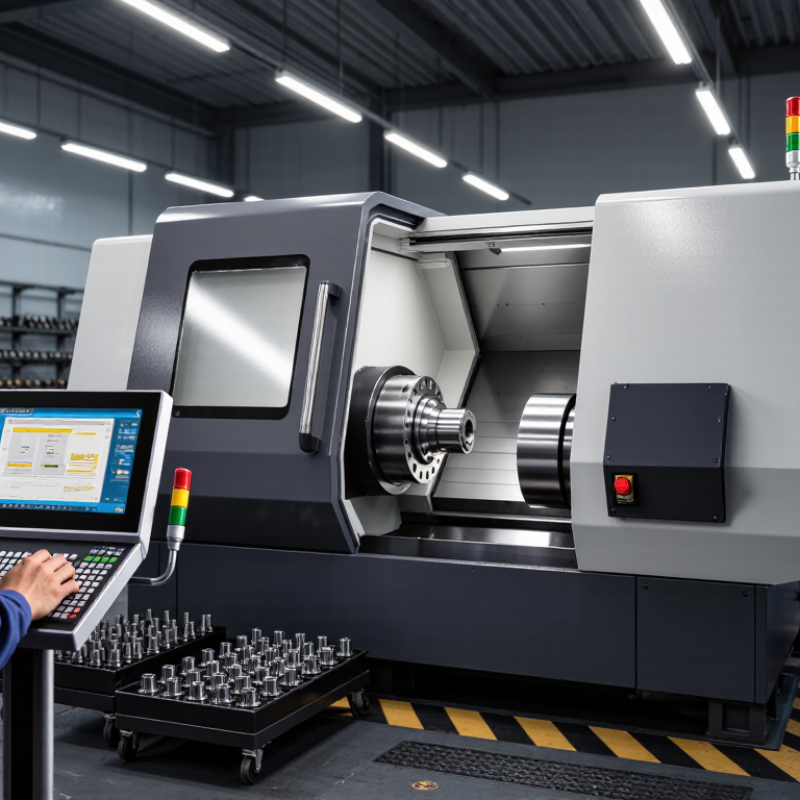
Choosing a turning cnc machine in 2026 is not a simple contest of spindle speed or price. The right choice depends on the parts you actually make: material, diameter, tolerances, batch size, and future workload. A long bar feeding through a guide bushing has different needs from short, heavy work held in a chuck. Small details matter. Chip control matters.

Grand View Research estimated the global CNC machine market at USD 101.22 billion in 2023 and forecast a 9.3% compound annual growth rate from 2024 to 2030. That figure covers CNC machines broadly, not turning centers alone. It signals investment, but it does not prove that a particular machine will pay off in your shop. Compare the report’s market context with your own cycle-time records, staffing, maintenance costs, and supplier support.

Machine-tool design also rewards system-level thinking. MIT mechanical engineering professor Alexander H. Slocum’s work emphasizes evaluating machines as integrated systems. Applied to this decision, his principle can be summarized as: “Judge the complete machine, not one headline specification.” This is a paraphrase, not a verbatim quotation. And it is worth admitting that forecasts and brochures cannot predict every shop-floor problem. Before buying, test representative parts, inspect finished surfaces, and ask operators to review setup access and chip evacuation. A careful trial can reveal more than another impressive specification sheet.
How to Choose a CNC Turning Machine in 2026?

Define Your Production Needs and Part Requirements

Before comparing CNC turning machines, list the parts you expect to make in 2026. Record each material, maximum diameter, finished length, and tolerance. A stainless-steel shaft with a 0.02 mm tolerance creates different demands from a short aluminum sleeve. Include annual volumes and batch sizes, too. Small batches differ. A machine optimized for long production runs may spend too much time changing over for frequent, varied jobs.

Check how parts will be held and fed. Will you use bar stock, individual blanks, or both? Note whether parts need live-tool milling, sub-spindle work, or a second setup. These choices affect the required spindle capacity, tool positions, bar-feeder compatibility, and floor space.

Keep measurements from actual parts nearby, rather than relying only on drawings. A drawing can hide awkward loading or tool access. That matters.

Set realistic targets for cycle time, uptime, and inspection. Ask operators which steps cause delays, such as changing tools or clearing chips. Then compare those needs with the machine’s working envelope and available automation. A faster spindle is not automatically a better fit. I have seen planning focus too heavily on maximum speed while overlooking setup time. That’s an easy mistake to make. A simple spreadsheet of part families, tolerances, and monthly quantities can reveal whether one machine can handle the workload—or whether flexibility matters more than raw output.

Choose the Right CNC Lathe Configuration and Capacity

How to Choose a CNC Turning Machine in 2026?

Choose the Right CNC Lathe Configuration and Capacity

Start with the parts you make most often, not the largest part in your catalogue. Check maximum turning diameter and length, then allow room for chuck jaws, tool clearance, and safe loading. Measure actual stock, too. A bar-fed job may need more spindle bore capacity than its finished diameter suggests. Measure twice.

For simple turned components, a two-axis configuration may cover the work without adding setup complexity. Parts with cross-holes, flats, or milled features may benefit from live tooling and a Y-axis. A sub-spindle can reduce handling when parts need machining on both ends. But extra axes are not automatically better; they add cost and require programming and maintenance skills.

Match spindle power and torque to your materials and typical cuts. Stainless steel, for example, can demand steady torque at lower speeds, while small aluminum parts may favor higher spindle speeds. Review expected cycle times, tool capacity, chip management, and how operators will load parts during a real shift. A machine that barely fits today’s busiest job may feel restrictive later. Still, buying far beyond likely demand can leave expensive capacity idle. That trade-off deserves an honest production forecast.

How to Choose a CNC Turning Machine in 2026?

Representative turning-diameter planning examples by machine configuration

Use the largest part diameter and length to narrow your options, then confirm the machine’s actual maximum turning diameter, turning length, spindle bore, and bar capacity. The chart values are illustrative planning examples—not standardized capacity ratings; specifications vary by machine model and setup.

Compare Core Specifications, Tooling, and Automation Options

How to Choose a CNC Turning Machine in 2026?

Compare usable capacity with actual part drawings, not the largest figures on a sales sheet. Check maximum turning diameter, distance between centers, bar capacity, and chuck size. Then review spindle torque at the speeds your materials require; peak power alone can be misleading. Ask for a sample cut and inspect surface finish, dimensional consistency, chip control, and cycle time. Test the setup. Tooling matters just as much: count turret stations, confirm tool-interface compatibility, and decide whether live tooling or a Y-axis suits your parts. More features can add cost without improving your daily work.

Automation choices should match production volume and part handling. A bar feeder supports long runs, while a parts catcher or robot may help with frequent changeovers. Check how easily operators can load parts, clear chips, and recover from an interrupted cycle. The International Federation of Robotics’ World Robotics 2024 report recorded 541,302 industrial robot installations worldwide in 2023, with 4,281,585 robots in operation. That signals broad adoption, not guaranteed savings for every shop. One assumption deserves a second look: automation only helps when the machine, tooling, and workflow are coordinated. During a factory trial, time the full cycle, including setup and part removal, not just cutting.

Evaluate Controls, Service Support, and Total Ownership Costs

When comparing CNC turning machines, look beyond the control’s screen size. Test a sample program, check how operators edit offsets, and confirm that alarms are clear and searchable. Ask whether programs can be backed up and transferred without manual re-entry. Small details matter. A confusing interface can slow a new operator during a real setup, not just a showroom demonstration.

Controls also affect how well a machine fits your production data and workflow. Deloitte’s 2023 Smart Manufacturing Survey found that 86% of surveyed manufacturing executives expected smart manufacturing to drive competitiveness within five years. That figure is not a machine-performance guarantee. Still, it supports checking connectivity, data access, and integration before purchase. Request a live demonstration using your part geometry and tooling plan.

Service support belongs in the cost calculation. Ask for typical technician response times, spare-parts availability, training hours, and remote diagnostics. Deloitte and The Manufacturing Institute estimated that up to 2.1 million U.S. manufacturing jobs could go unfilled by 2030. Their 2021 workforce study makes operator training a practical concern, not a minor extra. Build a three-to-five-year ownership estimate covering tooling, coolant, power, software, maintenance, training, and expected downtime. Downtime gets expensive. Compare cost per good part at your expected shift pattern, and question estimates that assume perfect uptime.

Verify Machine Performance Before Making a Purchase

Before choosing a CNC turning machine, verify its performance on your parts, not just a showroom test piece. Ask the supplier to cut your material using your drawing, tooling, and intended cycle settings. Measure diameter, roundness, surface finish, and repeatability across several parts. Check again after the spindle warms up; thermal drift can shift dimensions. Numbers matter. ISO 230-2:2014 describes tests for positioning accuracy and repeatability of numerically controlled machine axes, providing a useful basis for reviewing test results.

The International Federation of Robotics’ World Robotics 2024 report counted 4.28 million industrial robots operating worldwide in 2023. That figure does not prove any particular lathe performs well, but it shows why stable results and reliable machine-cell integration matter. Test the turning machine with its intended bar feeder or handling setup, if applicable, and record cycle time, tool changes, alarms, and rejected parts. Request raw measurement records, not only a pass statement. A single successful cut can be misleading. Repeat the test over a practical production run, then inspect parts from the beginning, middle, and end. The test may not match every future job, either; document what it does not cover.